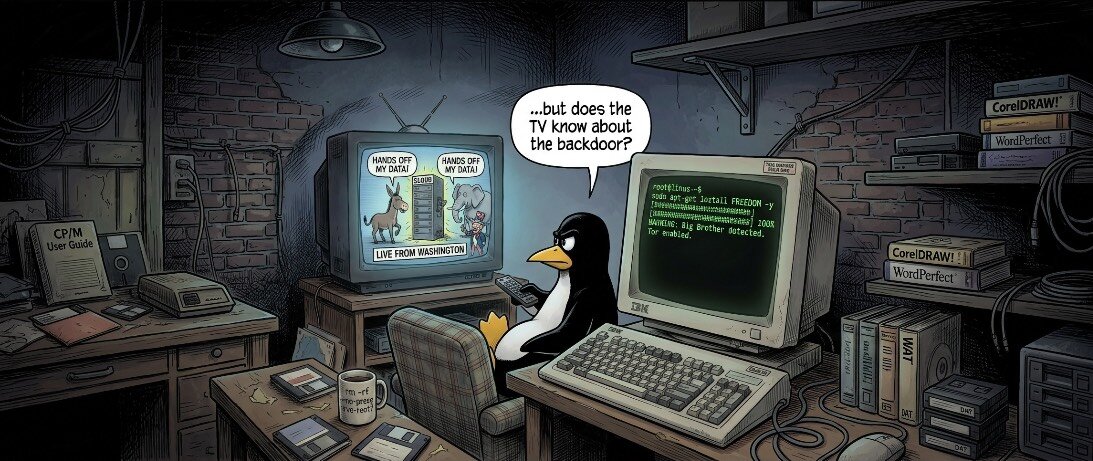
Many people own “smart” televisions, which is to say sets or boxes connected to the internet. Practically none of those people have read their televisions’ privacy policies. If they had, they would be horrified.
A lot about you can be learned by monitoring your television set. Even more can be learned if that TV has its own camera and its own microphone, as many do, and those things were controlled by the manufacturer (with your permission, as specified in the privacy policy).
Can the television viewer do anything about it? Of course. You can stop watching television, a strategy that has much to recommend it. As hundreds of years of drinkers, smokers, gamblers, and more recently voters demonstrate, we do not always or even often do something just because it’s the sensible thing to do. We’re not going to discard our oh-so-convenient television sets (or its frog-in-the-saucepan subscriptions).
Some of us have undertaken to confound data scraping by content providers. A while back I cooked up a little system (and here, too) that converted my spyware-infected TCL television into what’s in effect a 55-inch dumb computer monitor. (It’s still angry about it and registers its complaint by constantly flashing a bright LED — extremely annoying until I exposed it to the power of opaque black electrical tape.)
The project involved building a very small computer employing a Raspberry Pi motherboard, installing Linux on it, adding an application called IPTVnator, and hooking it up via my (optional but recommended) Proton VPN to my local WiFi. Then I took away the television’s internet permission, plugged the tiny computer into a port on the former TV — I plugged my over-the-air antenna into the little computer as well, and used an application called Kaffeine to make use of it, too — and ended up with private television that actually offered more television than the TCL software offered.
I was and continue to be entirely happy with my home-brew television sets (I made two). But it isn’t something most people will do — remember, most people haven’t read their television’s many-pages-long legalese privacy policies. Have you?
I do not know if you are familiar, though you should be, with the term “free software.” It’s not about price, though free software frequently comes free of charge. Free software comes along with the availability of its source code and permission not only to copy the software and the code but also to modify it, as long as you do not distribute it without following the same rules, including any modifications you have made to the application you are distributing.
Free software is controlled by a license — often called “copyleft” — which specifies those requirements and others. Most commonly this is the GNU General Public License.
“To protect your rights, we need to prevent others from denying you these rights or asking you to surrender the rights. Therefore, you have certain responsibilities if you distribute copies of the software, or if you modify it: responsibilities to respect the freedom of others,” says the preamble to the GPL as it’s called.
“For example, if you distribute copies of such a program, whether gratis or for a fee, you must pass on to the recipients the same freedoms that you received. You must make sure that they, too, receive or can get the source code. And you must show them these terms so they know their rights.”
What has this to do with television sets?
The excellent Linux operating system is governed by a version of the GPL. And because it is free and superior to anything else — Windows would no longer exist but for it coming pre-loaded on computers, and yes, you paid for it — Linux is the operating system used by your “smart” TV, which is after all a computer even if you haven’t modified it.
Because of that — perhaps the GPL hasn’t been translated to Chinese — the “smart” TV operating systems and their modifications, as well as the source code, by law must be made available to anyone who wants them.
As you surely can imagine, the people who make most of their money by spying on their customers under the cover of a (lack of) privacy agreement are willing to hide under that legal nicety but they are happy to utterly ignore the legal obligation they assume when they use software guaranteed free under the GPL.
And now the fun begins.
It was with unusual delight that last week I saw an article in Ars Technica that says that one maker of “smart” televisions is finally being dragged into court for violations of the GPL. The Vizio company, purchased not long ago by Walmart, has been trying to wiggle out from under a suit brought five years ago by the Software Freedom Conservancy, an outfit that exists in some measure to make sure that those who avail themselves of the benefits of the GPL live up to their obligations.
“When Vizio chose to use Linux in its TVs, it accepted Linux's reciprocal contract, which gives purchasers all the rights that Vizio had, to modify and install the software onto the Vizio TV,” the organization writes. ”However, when SFC asked Vizio to hold up its end of the bargain, by giving SFC the source code that SFC was owed so SFC could make the TVs better serve their users, Vizio refused. After multiple years of back and forth with Vizio, SFC knew the only way Vizio would comply with the license and give SFC the CCS was to sue Vizio. So in October 2021 SFC sued Vizio in California state court.”
After much legal volleying, the lawsuit is scheduled to go to trial in early August.
In a lengthy, rare post on the Linux kernel’s social mailing list after Judge Sandy Leal issued tentative findings last December, Linus Torvalds, inventor of the Linux kernel, criticized both parties and, as is typical of him, did not hold back.
“The court case itself is a mess of two bad parties: Vizio and the SFC. Both of them look horribly bad in court - for different reasons.
“Vizio used Linux in their TVs without originally making the source code available, and that was obviously not ok.
“And the Software Freedom Conservancy then tries to make the argument that the license forces you to make your installation keys etc available, even though that is not the case, and the reason why the kernel is very much GPLv2 only.” (It is important to note here that there are various versions of the GPL, and the one governing the Linux kernel is version 2, which covers the software but not its application on specific hardware.)
In the tentative ruling, the judge wrote: “Vizio must ensure the ability of users to copy, change/modify, and distribute the source code, including using the code in other free programs consistent with the Preamble and Terms and Conditions of the Agreements. However, nothing in the language of the Agreements requires Vizio to allow modified source code to be reinstalled on its devices while ensuring the devices remain operable after the source code is modified.”
Apparently Vizio has released some source code. But not all of it, and not in a form that satisfies the GPL, the Software Freedom Conservancy contends. Thus it will go before a jury in California in August.
What can be made of all this at this point? It’s hard to tell, even more so because it will be a jury trial, and juries, especially California juries, are known to be a little nutty. If Vizio loses substantially, appeals could tie it all up for additional years. Perhaps there will be a settlement before the trial begins; we cannot know if the settlement would be useful or useless. Most “smart” television makers based their operating systems on Linux, so while Vizio is the defendant, the whole industry has pixels in this litigation.
Noted the Ars Technica story linked above, “Ads and tracking have been Vizio’s primary focus for years. Walmart doesn’t share Vizio’s financials, but in the quarter before its acquisition, the company’s ad business made \$115.8 million, and its hardware business lost \$6.7 million.” It has been long reported by others (and me) that those big TVs are being sold cheaply because the companies are making their profit by selling your information. I was thus not surprised over the weekend to see that my local Walmart was selling 50-inch Vizio televisions for \$170. New Vizio televisions require buyers to create a Walmart account, on the television, before they will work. I wonder how many owners of a shiny new cheap television stop for even a second to wonder why that is.
As I mentioned above, I don’t have a dog in this fight anymore. One of my televisions is the TCL, while the other is a cheap 32-inch computer monitor to which I added my own speakers and a second little Raspberry Pi computer that I built in a little under an hour — and I’m no special whiz at this; pretty much anybody could do it.
Still, it would be nice to buy a television and to be able, the way I’ve been able for decades with laptop and notebook computers, to blow away whatever software came on it and install what I’d like.
Perhaps the trial will result in that ability. If it does, you can bet that the free software world will quickly crank out new and better television software and make it available for anyone who wants to use it, modify it, and pass it along to others. 

Dennis E. Powell is crackpot-at-large at Open for Business. Powell was a reporter in New York and elsewhere before moving to Ohio, where he has (mostly) recovered. You can reach him at dep@drippingwithirony.com.
Pass along this article.
Never Miss Another Article from Dennis E. Powell.
You need to be logged in if you wish to comment on this article. Sign in or sign up here.


Start the Conversation