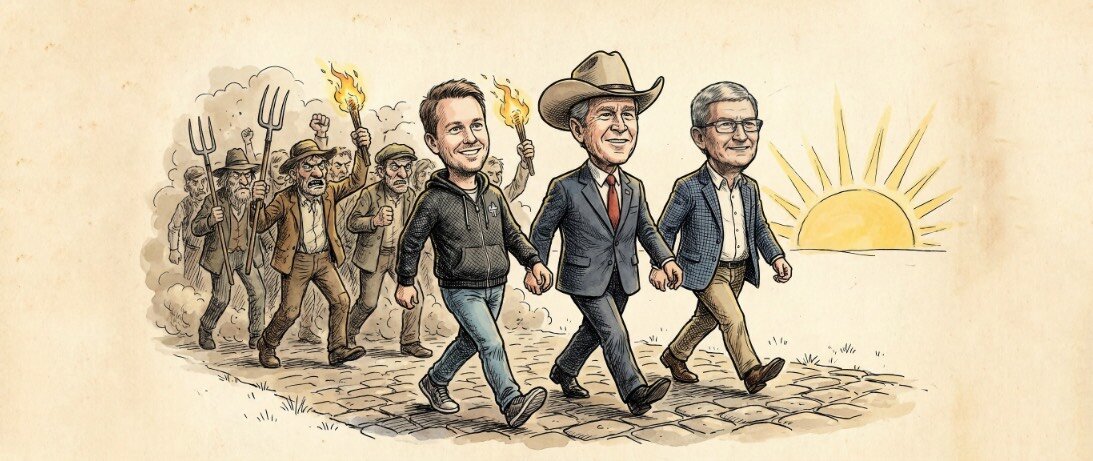
The last decade, we’ve been told we have to speak — and speak loudly — or we’re the bad guys. And, of course, say what the mob says or we’re still the bad guys. But silence is often more profound.
Look, I’m bad at being quiet. I am full of hot air. But I remember when we used to know there were times to stay quiet and we respected when people did. Two tech figures and a president make the point.
If there has been any leader in Big Tech who is quintessentially comfortable with silence, it’s Tim Cook. During his fifteen years at the helm of Apple, most of us learned precious little about him. He loves Apple, Steve Jobs and staying out of the public eye beyond a carefully defined, limited, reserved presence.
(I was going to write “persona,” but by all accounts that is Tim Cook, not an act he plays.)
No one who watches Apple thinks it is anything but left-leaning. Apple does — to a limited degree such as watch bands — a touch of “pride” every year, but it doesn’t change its logo like was so in vogue a few years back. Apple advocates for the environment, but by being cleaner in its production, not by virtue signal shouting.
In other words, Apple doesn’t lack for opinions, but neither does it feel like it needs to shout them. It makes products for everyone, negotiates the world it lives in and quietly tries to make the world more like it thinks it should be along the way.
Over in the Linux world, Ruby on Rails creator David Heinemeier Hansson (DHH) is… not much like Cook. A brash and loud voice in tech for years, whatever he takes on seems to have a bit of a tempest about it. I don’t always get the excitement around whatever he’s focused on — Omarchy, a new Linux distro at present that I don’t yet understand the excitement over — but he’s always had a gift for getting people talking.
Ironically, though, there is a way he parallels Cook. All of his talk about Omarchy has been about its very opinionated product design. DHH himself has not refrained from making loud political statements in the way Cook has, but today the controversy — ironically — is on his desire to make Omarchy about something other than politics.
Some of that came from the Left, where, for example, the vocally LGBT-activist founder of ElementaryOS complained that somehow supporting the new Omarchy foundation was supporting “ethnic cleansing”. Then the Right had to jump in, with a Daily Wire piece labeling the project as an “anti-woke operating system”.
But, for all of Omarchy’s technological opinions and its founder’s political proclivities, Hansson’s point has been to be technologically _not politically opinionated in his actual products and company, whether Omarchy or 37Signals.
The distribution takes a very idiosyncratic path to a computer operating system — an unusual fusion of keyboard-first control and a graphical interface — but not every unrelated world opinion needs to be attached to doing something interesting in tech. “Everyone is welcome here. Just leave leave [sic] the identity politics (and all other kinds!) at the door. No land acknowledgements, no code of conduct struggle sessions. Just nerds and artists and people who love computers having fun building something amazing together,” he responded.
To Daily Wire’s credit, they actually listened and updated the article when Hansson complained that they were framing his work as anti-woke instead of simply wanting to be free of picking and broadcasting an ideology, woke or not.
Maybe they even got what he has been leaning into with the distro and company: not everything needs to be said, not every place needs to be turned political. The opposite of leftist activism — such as opposing a Linux distribution simply because its founder isn’t himself far left — isn’t rightist activism, but refusing to make everything a virtue signal.
I don’t care if the founder of ElementaryOS is far-left or creator of Omarchy is to the right. Why does it need to matter if every person who touches something I use agrees with my every political checkbox? Maybe just maybe, sometimes software does a job and the end user can decide whether to be political or not. And maybe that actually accomplishes more than all the screaming.
Which brings me to a president: George W. Bush. Bush has been enjoying something of a resurgence in popularity for being, well, not of our current political age. When I saw the New Yorker was running a profile on him, I figured it might embrace that.
No, instead, it actually blasted the president anew. After some remarks about the sorts of things the left-leaning commentariat brought up during his presidency, its new attack was that he has (quite famously) chosen not to speak about President Trump. Instead of taking the route of most politicians of our age, Bush has aspired to be something different: an American president, an elder statesman. He raises money to help veterans and tell the stories of immigrants through his paintings; he doesn’t do politicking.
If you read that carefully a few times, you’ll note that — just as Jacob Weisberg begrudgingly does in his piece — he does clearly have a political agenda there and one that, in the way he crafts it, is unquestionably at variance with his Republican successors. No one thinks Bush is MAGA any more than they think Cook is. But, like Cook, he doesn’t go on a podcasting circuit to yell about it (or yell for Trump, conversely). Instead, he tries to do something to help those he professes to advocate for.
And herein lies our moment’s problem. While many in Apple’s community are angry at Tim Cook for being willing to try to work with the government of the company’s home country while President Trump is in office, and not publishing big political screeds, Cook has probably accomplished more for the causes those angry people care about — say reducing carbon emissions — than most or all of the loud voices combined. (If he got Apple embroiled in a debate about politics, arguably, he would have accomplished less not more.)
Those now wanting to deconstruct the growing support around Omarchy on ideological grounds are trying for the same kind of defeat. Keeping in mind Omarchy is free and open source software, the foundation won’t even enrich Hansson (who is a donor to it, not a recipient); on the contrary, such open source efforts inevitably benefit ideological fellow traveler and foe alike. These are by definition tools anyone of any political or ideological stripe can use. Tools that even activist founders of other Linux distributions can use.
In other words, opposing the project because you disagree with its founder, accomplishes less not more.
And, with Hansson and Cook, so too with Bush. The New Yorker bewails that Bush doesn’t slam vocally President Trump’s cuts to programs like Bush’s signature PEPFAR HIV/AIDS relief program. It acknowledges Bush has made his opposition to ending it clear, but Bush didn’t slam Trump and therefore he’s bad afresh. That’s the whole shtick of the piece as it dots from issue to issue Bush and Trump differ on.
In contrast, the piece held up the stands of someone it surely hated more over time (Vice President Dick Cheney) and that person’s daughter (Rep. Liz Cheney), Republicans who spoke out strongly against Trump. To be clear, I’ll stand up for politicians of either side who speak their conscience, but I must ask: did they accomplish what they wanted to accomplish?
No. It made it so those who weren’t yet of like mind simply quit listening to them at all.
I can’t and won’t say they were wrong to speak. I strongly dislike the mentality that wants hundreds of duly elected politicians to march in lockstep conformity to their respective party leaders. Why bother electing the other 533 members of Congress, if they all must vote and speak in conformity to their party’s leader all the time?
But, would a former president like George W. Bush have more or less ability to affect the things he cares about by being super vocal and direct in opposition to President Trump? We all know the answer: less.
Bush would not convince a lot of current Trump supporters to change tacks any more than the Cheneys did. He would not convince the current president to restore PEPFAR by getting into the mud with him. He can and through his foundation does actually help immigrants, veterans and people in need around the world while he refuses to feed the fracas.
I’m sympathetic to the dilemma of all three of these figures even as I have my own places of agreement and disagreement with each. As a pastor, I too try to stay outside of the direct political fray. Not indifferent to things that matter — I attempt to speak unequivocally of Biblical principles and morals and not flinch — but to focus more on the need to live them than endorsing candidates or rallying for parties.
Many suggest clergy like myself are compromisers or somehow support the other side (whichever side that may be) by not becoming overly opinionated podcast bros. But, would I accomplish more of what I believe I’m called to do if I got into all that? No — my calling is to preach of the Savior and the hope people who don’t even know Him yet have if they turn to Him. The last thing I want is for people to miss that because all they hear are my latest trendy political ramblings.
(This is not to say I do this perfectly or always balancing things well. But, I do get where those pushed to take stands, and who instead try to operate in the multitude of life concerns that aren’t just political partisanship, are coming from. I respect them for not succumbing.)
Virtue signaling should never be viewed as superior to doing the hard work of accomplishing the things we otherwise merely “signal.”
We’ve been told the lie that “silence is violence,” we shout at the top of our lungs our woke (left) or now woke (right) angst and we wonder why nothing gets done. But maybe we ought to look at those who do get things done. Cook, Bush and even a loud mouth like Hansson who wants his products themselves to be welcomingly apolitical — these are people who are actually accomplishing things they care about while those around them scream about caring.
Ineffective noise is loud, but awfully silent in the end. 
Timothy R. Butler is Editor-in-Chief of Open for Business. He also serves as a pastor at Little Hills Church and FaithTree Christian Fellowship.
Pass along this article.
Never Miss Another Article from Timothy R. Butler.
You need to be logged in if you wish to comment on this article. Sign in or sign up here.

Start the Conversation