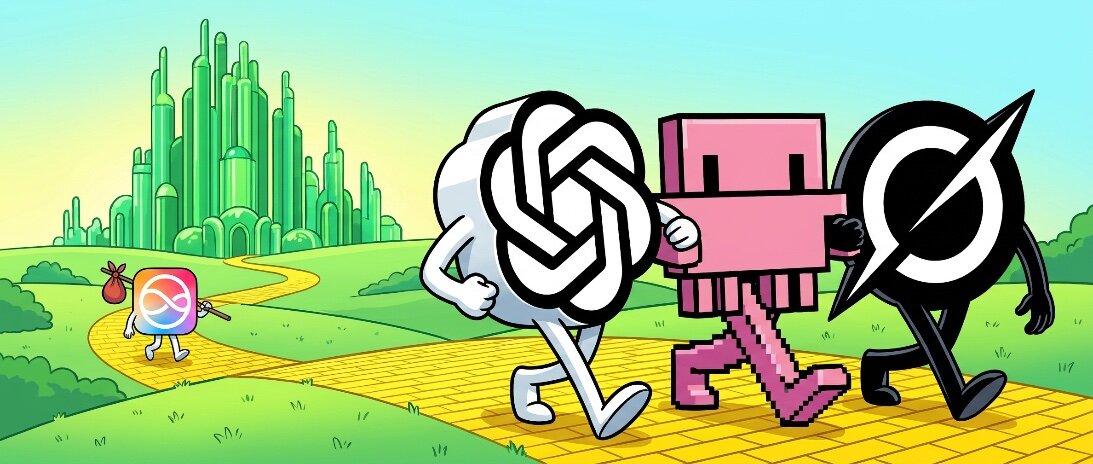
I’m closer to “Inbox Zero” than I’ve been in years today. I’d like to say that’s because of Apple’s spiffy new Siri AI. It isn’t. It doesn’t do that. But Siri AI teases a future and those already accomplishing that future show what Apple needs to do next.
No one — not even Apple — is trying to posit that Siri AI is on the so-called frontier. That is occupied by Anthropic, OpenAI and the dark horse lab (that conventional wisdom generally leaves out) SpaceXAI. They have each arrived at doing what Apple promised two years ago: not chatbot gizmo, but a worker that can actually look at your stuff and do stuff with that stuff for you. Instead of making us research assistants to a chatbot, bringing information to it, agents bring the relevant materials to us.
Two years ago, Apple showed what appeared to be a massive leap beyond to the front of the AI race on the productive points that mattered most. The introduction of Apple Intelligence at WWDC 2024 suggested Apple’s decades long journey with “machine learning” had been properly focused and the company was now going to pass everyone else up with an amazing use of both on-device and impressively secure cloud AI to fulfill the dream of a true AI “personal assistant.” Not merely “Siri, should I bring an umbrella with me,” but “Siri, when’s mom flying in and where can we get a dinner reservation that coordinates with the flight?”
It seemed almost too good to be true.
It was too good to be true. I won’t repeat my full criticism of Apple’s lack of vision, but needless to say, the reason Apple succumbed to showing concept videos as if they were real betas in 2024 was that it frittered away decades of being on the cutting edge of what we now call AI distracted by a VR headset and an unreleased car.
What was impossible for Apple has actually reached us, though, just by way of the new tech titans. Claude Code arrived to ostensibly blaze a trail on programming work, but a tool that can code and iterate on that code by itself and, when given the chance, can apply the same dogged determination to any project on your device. Ditto Codex and Grok Build. What makes a good app builder happens to also make a good general purpose “I need this done, Computer, do it for me” type sci-fi-that-isn’t tool.
I turned Grok Build onto my newly installed OpenWRT router and had it take the networking settings I’d hand tuned on OPNSense (which was nice, but didn’t work well on my hardware) and transcribe them to OpenWRT-ese (which was less nice, but worked on my hardware). It worked. When various parts had trouble, it could locate the problematic spot faster than I could even speculate on the possibilities. I kept it on a short leash lest it do something I didn’t want, but this is transformative to system administration.
Still what about normal users? Siri AI is, at least, far better for normal users who don’t keep a terminal window open all the time, right? Not so fast. These frontier labs’ tools have all gained graphical clients capable of working in the same way.
A few weeks back, I wanted to export out information I’d entered into our church’s volunteer management system. That system has convenient import functions, but no bulk export tool. Rather than dutifully pull up each one of 250 or so entries and manually pull the data out into a spreadsheet, I asked Claude to do it. Claude opened a web browser within its secured box on my computer, I logged it in, and it went through each page and did the mundane but necessary work of scraping the pages into a usable spreadsheet.
That is transformative well beyond system administration. We all have jobs we’d rather not do, but need to do, that present level AI capabilities are more than sufficient for.
Which brings me to SpaceXAI’s newly released “Grok Bot.” At first I took it as a catch up to Claude Desktop. The more I play with it, the more I’m thinking it is a step beyond and closer to what I wish Siri AI were today. While Claude could show me a web browser and control it, Grok Bot has its own little cloud computer it lives in with its own graphic interface it can work with to do things (Debian 13 running XFCE, if you’re curious), whether your personal computer is on or not. If you want to train it, you can even remote into its computer and teach it something.
I experimented with Grok Bot as soon as it became available on the mere mortal X Premium+ plan instead of the eye-wateringly priced top tiers. Another mundane task was its first job. I had 70GB of video recordings for ministry events crowding my SSD, but they needed to not only be moved to my NAS, but first sorted so that they weren’t just a pile somewhere. Looking at the file names and modification dates, a human could figure out how they clustered together and put them into sensible folders. I could do it, I just never had the hours to do it.
I gave Grok Bot the general sense of how things might be related and turned it loose. Grok Bot obliged, followed my instructions and then calculated “checksums” on both sides, so I could verify the files copied byte-for-byte. Only after that, we deleted the files.
A huge timesaver and incredibly enticing to run on a whole bunch of organizational matters that have eaten at me for years — but not been critical enough to get solved. On-device work like that is in the purview of every one of these agents and they’re getting better at it every day.
But the “cloud computer” portion — that Linux desktop each Grok Bot agent one creates gets — is the part that really makes me wish Apple would catch up. Imagine it were Apple’s Secure Cloud Compute where that cloud computer lived as a small MacOS or iOS instance.
Take my Inbox Zero target I mentioned upfront. It’s been far too long since my e-mail box had no unread messages. Like most people today, I get an overwhelming amount of not-quite-spam-but-not-quite-high-value messages that can lead me to miss ones that are of high value. What if a Bot could help with that?
I created a “secretary bot” and logged into my e-mail’s web mail from the bot’s little cloud computer. It dutifully spotted spam and moved it into my spam filter training folder; opt-in commercial mail into my opt-in folder; and, group e-mails I didn’t need to weigh into went into another folder. Meanwhile, it surfaced e-mail I may have missed and provided overall trends of the whole situation. While this sort of work has taken me an afternoon any time I’ve attempted it, with my “secretary bot,” it did the whole thing within about a half hour while I worked on something more pressing.
Automating these mundane tasks is an ideal AI use case. It also offered to reply to e-mail for me, either by drafting things for my approval or just going ahead. Thanks, but no thanks — I’ll still write for myself, even if it can do a passable job. That’s a human job when writing another human. But, moving e-mail that is getting in the way of that human job to somewhere it won’t clutter things? Perfect for AI.
But, which AI can be entrusted with it? Do I really trust SpaceXAI with my inbox? Anthropic? OpenAI? No. I wish I did — and of the three, I probably trust SpaceXAI the most, but I have no reason to think I can trust any of them. And neither should you. Do I trust any of them to automatically move files for me, rather than just listing them and getting me to approve it? No, again.
There’s such a tension here. This is a dream for anyone who feels stretched thin and wants to get to his or her real work and not the ten billion competing bits of noise that distract us along the way. E-mail was delightful until it became trudging through a deluge of junk mail, automated mail and the like. It’s a hint of that dream Apple promised with Apple Intelligence, where one just needs something and the machine does the mundane so the human can do the meaningful. More than a hint, actually.
But, Apple’s wilderness period leaves the dream in the hands of those who are hardly deserving of this level of trust. If we’re going to give AI carte blanche access to our data — and that is what unleashes the possibilities — we need to know it’ll keep things private. Today, we can’t know that. Apple was exactly right to try to solve this in a provably private-from-the-start way. Yet by underinvesting in AI, they can’t actually provide that privacy to us, the users.
The key that made Apple’s promise so alluring was that most of the work happened on device (thanks to Apple’s long term work on “neural engines” that make even its phones capable of so much AI work). And, when on-device wasn’t feasible, that Secure Cloud Compute as a fallback: an auditable online virtual computer that could do work that was provably untrackable by Apple or others.
It isn’t too late for Apple to take its rightful privacy protecting AI prize. But it needs to stop dawdling for its own benefit and ours. Running on a Google Gemini-based model, as it is now doing, will only take it so far and a once-a-year iteration of Siri will not catch it up with the Big Boys that often update multiple times a day.
What we need is for Apple to finally do what I advocated for years ago: leverage the numerous Apple devices often sitting on the same Apple account idle (say a work computer, a phone, an Apple TV, an iPad) into cluster computing. Apple was early to making cluster computing semi-accessible decades ago with Xgrid, but inexplicably abandoned it. Apple’s willingness to embrace the Mac Studio and Mac mini for RDMA clustering over the last year is the right direction, but they’ve been oddly content to provide the underlying technology while buggy, tech oriented projects like Exo are the esoteric means to utilize it.
What if Apple’s signature polish and “just works” zero configuration approach was applied here instead of leaving its raw “MLX” clustering abilities for someone else to build on? What if an AI model good enough to deal with e-mail problems, organize files and the like ran in the background on one’s phone, iPad and MacBook while they charged?
Unlocking its systems’ power with the clustering techniques it has already pioneered would dramatically improve the user experience. Instead even old machine learning work, like photo organization, must be run through end-to-end on each device one owns. Clustering would devour that work with appetite remaining for modern challenges. Even a weaker contemporary AI model could eke through a lot of what needs to be done when given a household’s worth of Apple Silicon to work with.
Apple has done this. It knows how, it just needs the will to do it again.
Missing this is inexplicable, because it would not only serve us users well, but increase Apple’s bottom line while it did the most helpful thing. Right now, even a five year old Mac mini shows up for resale for close to its original MSRP — sometimes even more. Imagine if Apple did introduce AI Clustering (“Apple Local Cloud”?) and suddenly made people want to both keep their old Apple devices and build a larger cluster with new ones? If the used market constricted further, that would be pure upside for selling new Apple devices.
Of course, even clustering won’t fix a lousy model. But, Apple’s history gives the roadmap to fix that, too. When Apple needed a modern operating system, Steve Jobs’s NeXT-powered path was unafraid to make heavy use of (and contribution to) open source software to build a better system. It made the open source community better even while Apple maintained its famed love of control on the parts it cared about. That’s why many early Linux desktop advocates like myself landed on Mac OS X twenty years ago.
Likewise, when Apple needed a modern, dependable web browser so it wasn’t at Microsoft’s mercy on the most important technological revolution of the early twenty first century, it took hold of the open source KHTML and transformed it into the basis of Safari. Apple got off the ground quickly and everyone benefitted as the Mac got a good browser and the open source community got the impressive WebKit engine.
Being tied to whatever Google wants to sell Apple is not the long term winning strategy. It upturns Apple’s “control the most important technologies” doctrine under Tim Cook; and does so on a technology that makes web browsers look like a sideshow. But an open source model, improved and accelerated with Apple’s resources could change that.
The answer cannot be to have a still-too-limited, but tantalizingly close tool like Siri AI. What Siri AI does today is what it needed to do two years ago. Today’s answer is to meet or exceed Claude, Codex and Grok Bot in a privacy-centric way. The Apple way.
If Apple would embrace an open weights AI base and tie it into a similarly open low-level harness that Siri (and other Apple tools) could leverage, we could see rapid movement to a full throated competitor. Like the open source underpinnings of MacOS and Safari, an AI model is the underpinnings here of the things the company really cares about: a polished, privacy first set of products people really want.
Given Apple’s once-a-year cycle and seeming inability to jump all in, the nice-but-too-little Siri AI is likely all we’ll have for the next year. Come next year, Grok Bot and the others will probably be able to handle even more of the mundane we’d-rather-not-think-about-them tasks of daily life while Siri’s big bragging point will likely still be — “yay” — searching e-mail.
(Yes, it can do more than search for e-mail. But, it remains several long steps away from any sort of personal assistant agent.)
Jobs’s long ago return and rapid transformation of Apple provides the exact roadmap if the company wants to again catch up and surpass its competition. Here’s hoping Apple under new CEO John Ternus has that lesson from his predecessor twice removed in mind. 
Full Disclosure: Tim owns a small amount of Apple (AAPL) and SpaceX (SPCX) stock.

Timothy R. Butler is Editor-in-Chief of Open for Business. He also serves as a pastor at Little Hills Church and FaithTree Christian Fellowship.
Pass along this article.
Never Miss Another Article from Timothy R. Butler.
You need to be logged in if you wish to comment on this article. Sign in or sign up here.


Start the Conversation