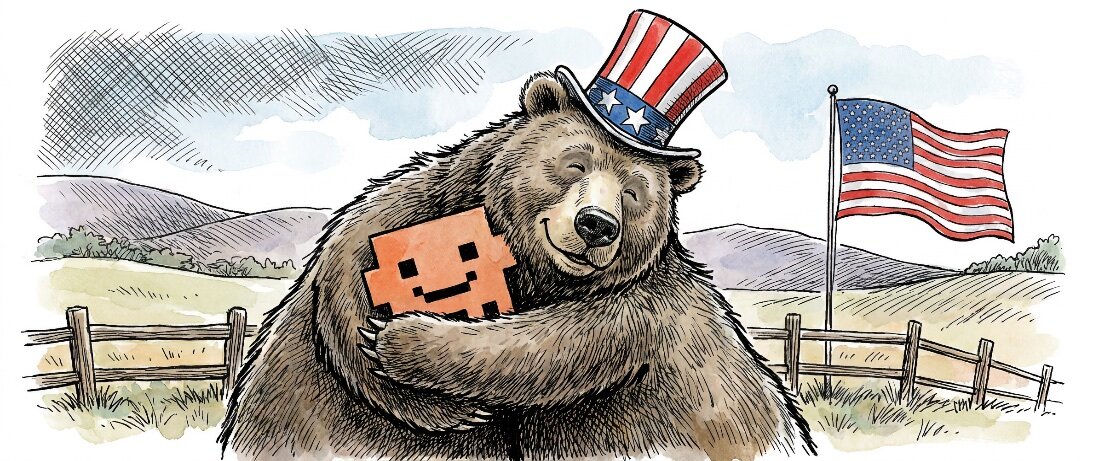
The twenty-fifth anniversary weekend of 9/11 was an ironic time for the Democratic Socialists and the Alt-Right to amplify their common war on AI. We may be on the cusp of a new PATRIOT Act. If we are, it’ll be as bad an idea as it was the first time.
As we remembered the horrors of 9/11, I was reminded of a few positive glimmers of societal unity — be it politicians across the spectrum singing “God Bless America” together after the attack or everyone who showed up in church the following weekend. But, even that wasn’t all good. 9/11’s brief cultural impact towards working together had a darker side too: unity that led to passing bills such as the infamous monstrosity that is the USA PATRIOT Act.
Swept up by an existential threat, too many in and out of government were willing to hand “safety” over to the government. The unity and good will evaporated all too quickly, but too many invasive surveillance state powers authored in the name of stopping terrorism never went away.
Only a few had withstood the currents of fear that pushed those draconian measures. Notably, the unusual duo of then Rep. Bernie Sanders and Rep. Ron Paul. As different as their political positions were generally, these contrarian voices found common cause on an important idea: you cannot protect a free, democratic society by stripping its freedom and democratic protections.
Twenty-five years later? Memorial reflections were paired up in the news cycle with a new tidal wave of fear and a new plan to solve it with a fresh batch of heavy government intervention. Brought to a frenzied pitch by anticipation for Sanders and Bannon appearing at a “pro-human” conference together, Anthropic CEO Dario Amodei again calling for more government regulation and a host of political hopefuls ahead of the midterms adding in, it made for one very loud choir singing something far less promising than God Bless America.
What was left unobserved in the coverage is the stark transition this present matter has marked for Sanders. In his opposition to the Patriot Act, the Vermont Democratic Socialist sought to protect librarians and booksellers from becoming unwilling eyes for the government’s rapidly expanding spy apparatus. Now, he wants to cripple the next century’s library — AI — via controls that would restrict who can build it or how well they can build it.
It’s easy to understand why he’s joining the litany of voices from across the spectrum in doing so, just as we can understand why most politicians voted for the tools to fight terrorism as New York smouldered. Sanders is well aware that the zeitgeist is against Big AI. Artificial Intelligence is big, it’s scary and the companies behind it have leaders who apparently glory in being creepy. It’s an easy, popular target.
Sanders, Paul and a few others bravely held onto something more important than feeding a fear mob a quarter century ago. But, for a man whose political house special is anti-corporatism, how could he resist when the special du jour is such a well matched pairing?
The zeitgeist was wrong in 2001, however, to sacrifice liberty for security. It’s just as wrong now.
It took years for most Americans to realize we were sacrificing too many civil liberties on the altar of antiterrorism efforts. We have yet to fully disentangle ourselves from that and probably never will.
Sanders might have understood that when he could use it to oppose the Bush Administration, but now not so much. Little wonder his cross-party comrades this time are “alt right” figures like Bannon and the authoritarian-leader admiring Tucker Carlson who stoke the mob rather than principled libertarians such as Paul who aimed to restrain it.
The Patriot Act ceded freedoms and our democratic values willy-nilly to battle the very real threat of terrorism. The fear of AI killing us is, in a sense, just a more abstract and as of yet unproven variant of the fear of terrorists.
In both cases, the threats are genuine, but so too the harm from ill-conceived reactions. The present proposals to regulate AI that Sanders and others pitch have the same fatal flaws you’d hope we would all recognize from before.
Perhaps it is our post-9/11 mindset (and a steady diet of Austrian accented killer robot stories) that conditions us to treat the threats of the technology as if proverbial planes had already hit present day towers. But if caution was advisable (it was) when planes had struck, how much more so when the danger is purely hypothetical?
First, any plan to introduce serious government regulation of AI will slow down American progress with the technology. In fact, that’s often the explicitly stated goal. China has already made it clear it has no interest in joining us in a slowdown. So, what does a slowdown mean? Not that AI slows down, but China gets to win the AI race.
I’ll resist any comment on Sanders being blind to the dangers of China because of shared ideological positions. Whatever he sees or doesn’t, and whatever Tucker “Isn’t Moscow an Amazing City?” Carlson sees or doesn’t, or whatever anyone else does or doesn’t, the rest of us need to be clear-eyed: AI could be an existential threat; China is an existential threat.
Ceding leadership of the most powerful technology of the Information Age to a country that desires to dominate the world is not a wise game plan. You might think Sam Altman, Dario Amodei or — gasp, the oligarchy is going to get us — Elon Musk are a threat to our freedoms and well-being. But, if you really think Musk is a greater threat to your wellbeing than Xi Jinping… I’m not sure what to tell you.
Second, giving government regulatory power over AI actually runs headfirst into one of the problems even the pro-regulatory Amodei acknowledged in his open letter: one or more governmental parties to such agreements might choose to secretly ignore the requirements for its own, governmental purposes.
(Of course, governments would never ignore regulations meant to restrain them.)
We ought to look at the right to develop AI much as the founding fathers did the Second Amendment. Justice Antonin Scalia observed that the amendment’s English forerunner was aimed to protect the citizens from errant kings. When the government has all the arms and the citizenry (or a disfavored group within the populous, at least) does not, the government can be as tyrannical as it wishes. For the sake of our present situation, it doesn’t matter if you take the Second Amendment as focused on state-level militias (as the Left does) or individuals (as the Right does), it clearly meant a Federal government shouldn’t have an absolute monopoly on power.
In the modern age, that equalizing effort may be of dubious value when it comes to weaponry since the American military so vastly outguns anything a civilian might possess. But, the government’s love of maintaining power has continued to show up in how it has fought technology — especially since 9/11 — that might diminish its complete superiority over the people it exists to protect.
It wasn’t long ago, the government wanted to regulate basic encryption technologies to prevent us from communicating outside of its watchful eyes. It continues to try to claw its way into technologies such as End-to-End (E2E) messaging and devices like the iPhone which resist being broken into.
No wonder anyone who enjoys being in positions of governmental power seems to want to regulate AI. If there is any technology that “threatens” to truly democratize the world, it is AI. If open source AI (or at least a diversity of free market providers) become the rule, it will only be a matter of years before most of us have access to tools that can do more than any one individual (or even a small team) could do. If government reserves the best for itself, it can be as powerful as it wishes, surveilling at levels we’ve only feared from science fiction in the past.
But, if AI undiluted by government tampering is available to everyone, it is the Second Amendment for the Twenty-First Century. The best way to hold in check the inevitable AI overreach of governments will be the ability to parry it with defensive private AI. De facto government tampering has already reared its ugly head. When OpenAI’s model escaped and attacked Hugging Face, American AI Labs’ government-encouraged reticence forced Hugging Face to use Chinese AI to sort out what was happening because American AI models are already handcuffed and viewed the victim as the attacker.
Which brings us to the third issue. We need model and provider choice to remain free. In the balkanized world of AI, where Altman and Amodei are advocating for having themselves regulated, we shouldn’t have to think long to understand why: it’s to their advantage that regulations form a barrier against new players so high that a few frontier labs can lock in a public utility style oligopoly (irony much, Sen. Sanders?). Musk’s industry peer review position, which parallels part of what the others want is better, but could still have the same effect if it somehow was the case that government looked the other way only for labs that played within that (likely to be exclusive) club.
The real path forward is the one advocated for by Jensen Huang of Nvidia and Satya Nadella of Microsoft: individual data sovereignty. Both Microsoft and Nvidia have signed off on an effort to promote open source, open weight models. To a degree, it may be a cynical play to avoid OpenAI and Anthropic gaining too much power, but whatever their motives, it is right: just as Linux and its orbit play a huge role in keeping the Internet free and decentralized, open weight models, by definition unable to be controlled by any large power, are the way you protect freedom in the AI age.
If those afraid of the tech titans really want to protect genuine liberty (and not merely preference a different tyrant), this is the path forward. We should not want a company or two or a government or international NGO to control the tools that will be key to both information distribution and work in the future.
That’s far more than King George ever could claim at the time of the American Revolution.
Regulation — whether through direct government control or blessed industry groups — is antithetical to this. How would a group of volunteers or a non-profit or even a consortium of small companies ever build a model if massive regulatory burdens sat up front for any model of top tier power? Even if some AI were still left unregulated, if good AI were to always fall under strict control, we would be welding slingshots against the Bomb.
And that is why we should care. The mistake too many Americans made in the rubble of 9/11 was to think that we must solve the danger now and worry about the side effects later. Trying to reach back in time and seize lost liberties is a tenuous bet. The time to worry about collateral damage is before the bomb goes off. And, as momentum against AI accelerates, the regulatory bomb’s detonation may not be that far away.
Yes, AI could prove genuinely dangerous, but make no mistake: it will not go away. The question is who do you trust to control it? Do you trust Altman and Amodei? Do you trust the government even when it is under the control of a party you didn’t vote for? If you can’t say yes to both of those, then don’t join the mob.
We need a Right to Bear AI. Right now, when no one entity has a complete upper hand on the technology, is the time to speak up for freedom. At some point, if we don’t, AI under a tyrant’s control might notice you speaking up. Hasta la vista, baby. 

Timothy R. Butler is Editor-in-Chief of Open for Business. He also serves as a pastor at Little Hills Church and FaithTree Christian Fellowship.
Pass along this article.
Never Miss Another Article from Timothy R. Butler.
You need to be logged in if you wish to comment on this article. Sign in or sign up here.


Start the Conversation