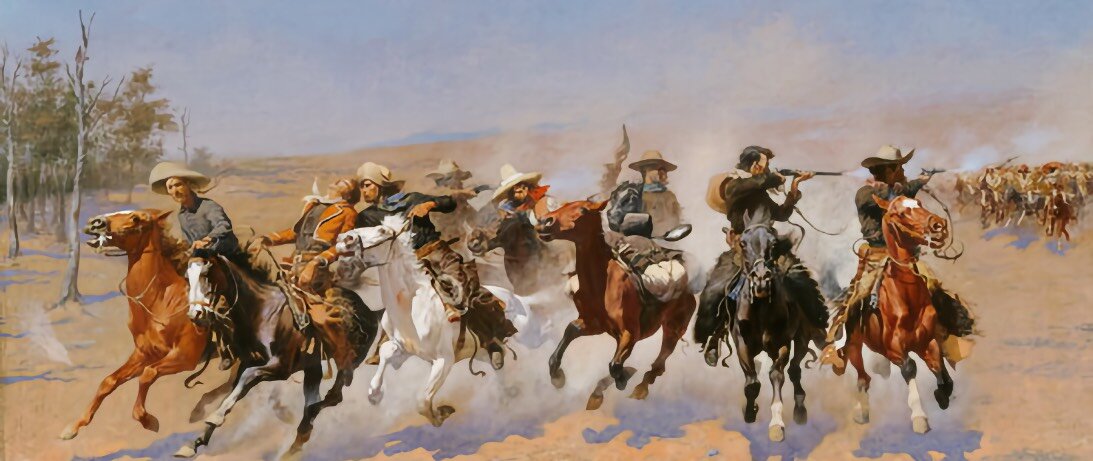
In 1959, the singer Marty Robbins released the Gunfighter Ballads And Trail Songs LP. You might recall that his all-time most popular song “El Paso” is on that album. In fact, it’s on there twice, in a short form and a longer form to conclude the album.
It sounds like if someone took all the John Ford westerns and made a record about them. One noted professor noted that the settlement of the western United States captures the American imagination in a way that few other things do. In context, he noted that only the Mafia, typified by Mario Puzo’s The Godfather, can rival it, in the American mythos. We like individuals, and we like underdogs.
Ken Burns’ The West admirably illustrates the tragedy inherent in settling The West, as so many cultures and nations of origin met there, sometimes at significant cross purposes. Obviously, bringing civilization and the assumptions of that culture changed the experience of living in what we know as The West.
The Louisiana Purchase and the subsequent Lewis and Clark expedition gave the United States a large portion of that land. War and its aftermath furnished the rest.
If you were going to romanticize a time for a narrative and popular culture for more than a century and close to two, the time after the Civil War and before the invention of the automobile (and subsequently, the airplane) would be a good time to choose. Perhaps we fear technology and its evergreen potential to replace us, or at least to displace those good things that make us human.
In 1967, NBC was airing the first season of the massively influential Star Trek, a franchise that I am certain will never die. In the episode “Court Martial,” Captain Kirk is accused of culpable negligence in the death of an officer under his command. He and the crew must somehow prove that the computer’s visual record of the events has been altered.
I can still hear his defense counsel Samuel T. Cogley, bellowing about “humanity fading in the shadow of the machine” before the climactic scenes. Trenchant, even today. For the record, I promise his congregation not to replace our esteemed Editor In Chief with an AI; we’re not seeming to lack sleep, on the whole. In any case, Roddenberry himself at least knew that a romance about the West had taken hold, because he pitched Star Trek to the network in 1964 as, “Wagon Train to the stars!”
Romance and tragedy seem to go together in even our stories about the West. Robbins’s erstwhile protagonist is usually getting shot with a gun, or hanged. In “They’re Hanging Me Tonight,” he most assuredly deserves it.
It’s also possible that Alexis de Tocqueville was right about us, well before we even struck out to the frontier. Restless, but longing for peace. 

Jason Kettinger is Associate Editor of Open for Business. He writes on politics, sports, faith and more.
Pass along this article.
Never Miss Another Article from Jason Kettinger.
You need to be logged in if you wish to comment on this article. Sign in or sign up here.

Start the Conversation