Here’s an idea.
Before I spell it out — without explanation, you’re likely to reject it out of hand, so let me give you the rationale first.
Years ago, when I lived back East, I would take a cross-country car trip from time to time. I highly recommend it.
It was enlightening, I discovered, to leave my watch set to eastern time, even though I would be passing through eastern, central, mountain, and whatever the California time zone is called. There is something enchanting about toodling along on Interstate 70 in western Kansas, passing into the mountain zone, and realizing that it’s a lot later back home. At such times, you’ll also note that 50 feet behind you it’s an hour ago.
The time zone phenomenon particularly struck me one summer night when my girlfriend and I were visiting Monument Valley, the site of all those John Ford westerns and one of the most striking locales in the country if not the world. For some reason unknown to me, we were the only people there. We had not seen a sign of other humans since the Tuba City Truck Stop, many miles behind us. We stopped at photogenic spots. I would make photographs and she would notice how her running shoes left footprints in the fine, red dust that made it seem as if we were on the moon, if the moon were red. The moon, not red, was rising as the sun was setting. It was gloriously memorable.
I looked at my watch and realized that back in New York it was coming up on 11 p.m. No one in that windowless newsroom at 524 West 57th Street, I thought, could conceive the scene I was witnessing at that moment. It was disappointing to ponder, and frightening. I didn’t want ever to be like them. When we got back to Tuba City, I pulled in at the truck stop and phoned CBS and quit (it was more than two weeks’ notice — we had long vacations at CBS). It cost me plenty, but I have never regretted it.
I digress. (As usual, you might be thinking.)
I didn’t think much more about time zones, except for the semi-annual insanity of Daylight Saving Time-related change, until a few years ago when I found and enjoyed “Republic of Doyle,” the delightful Newfoundland mystery-comedy-romance series. Newfoundland, one of my favorite places I’ve never been, I found out from the show (“I’ll hit you so hard it’ll set your watch back half an hour!”) has its own time zone, half an hour earlier than the mainland. Why? Dunno. But it was enlightening to learn. The time could be whatever they decided it was. Iran, a less-desirable place, is also off the standard by a half hour.
The point is, there’s no particular reason for time zones, no geophysical point to them. That’s why we can absurdly change them twice a year, and why some places — Arizona and Hawaii; there used to be more — say the hell with the whole idea.
Last week I noticed it when some Eurocrat (who keeps track of them? who would want to?) said at some European governmental gabfest that Russia has 11 time zones. My immediate thought was, so? This kind of thing is important to governments, I guess.
It got me to thinking about time zones.
It is immutable that there are 24 hours each day. If we wanted, we could count it as 12, but then they’d be twice as long, or any other number, but the lengths would vary because the world takes a fixed amount of time to make its daily spin back whence it started. What we have is as good as we’re likely to get. Hours will do.
Each hour, the sun, and the zenith at any point on earth, moves 15 degrees to the west. In navigation, one degree — 1/360th of a circle, is made up of 60 minutes, though this use of the word has nothing to do with time; there are 3600 seconds to a degree, but that has nothing to do with time, either, except that there are also 3600 seconds to an hour. This is no doubt all connected in some fashion, but it doesn’t matter for our purpose here.
Which is: Why bother to have time zones at all? Why not establish one time and have that it be it, everywhere? Is there any advantage to time zones? There are certainly disadvantages.
I’m entirely serious. We would be better off if we eliminated time zones entirely and let the time be the time. One time. Worldwide.
It would be easy: Pick a place, and when its 00:00 there — midnight in our common usage — it’s 00:00 everywhere. Nothing to it.
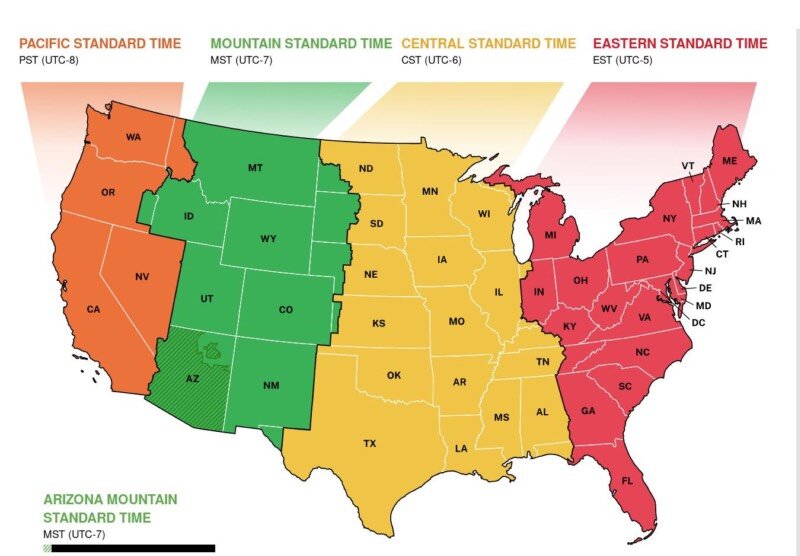
We’ve already been doing this. Have you ever heard of Greenwich Mean Time? It’s based on the time at the Royal Observatory in Greenwich, England, a place that once had some significance. It was important to know what time it was because that was necessary for navigation. You can learn the whole story by reading the surprisingly interesting book “Longitude.” But for our purposes it needn’t be Greenwich, which isn’t the official name anymore; now it’s called “Coordinated Universal Time,” or UTC, even though it applies only to the earth, not the universe. But the time by which time would be henceforth measured could be anywhere (and knowing how petty our countries and other institutions are there would no doubt be a lot of angry “negotiation”). I guess the fighting would be over license-plate-slogan rights or something.
It used to be crucial and difficult to figure out our location east or west, but north and south weren’t much of a problem. Longitude was hard, and mattered. Latitude, not as much. We don’t have north and south zones, because we didn’t need them and don’t.
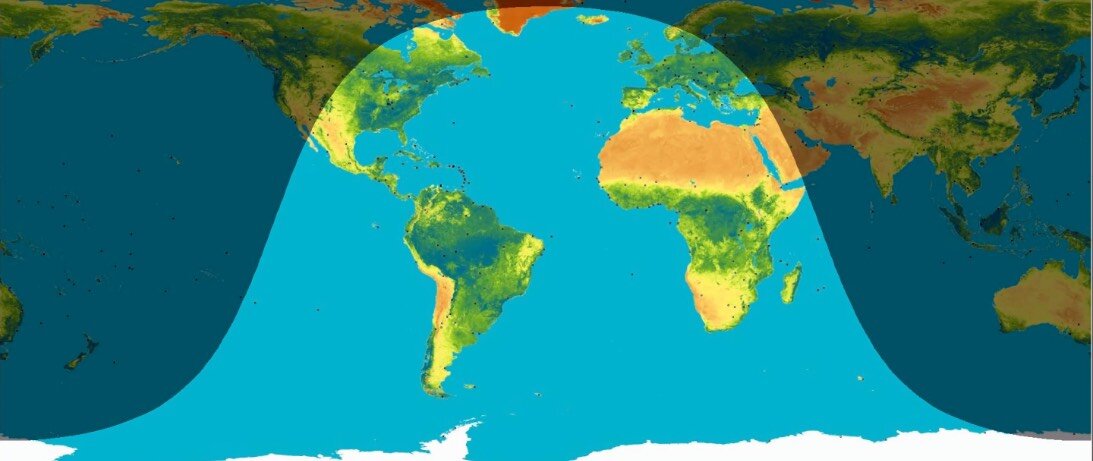
My personal favorite place for the establishment of an international time anchor to establish worldwide midnight already exists. It’s the International Date Line. It is the line up and down the Pacific Ocean where today becomes yesterday and tomorrow becomes today. Take one step west and it becomes tomorrow, one step east and it is yesterday once more, in both cases it being today. There would be nothing to negotiate because it’s already agreed to. (It doesn’t run strictly from the north pole to the south pole; it jogs east and west a bit to keep from running through places that, well, have license plates.) It currently crosses some time zones, but needn’t: it was designed to be 180 degrees, halfway around the world, from Greenwich.
Would it be difficult to establish a uniform earthly time? No. You just declare it, everybody changes their clocks, and it’s done.
The advantages are endless. At the same time we’d standardize the 24-hour clock, moving away from the one adopted when people apparently couldn’t count to 24, or watchmakers couldn’t make a 24-hour clock. (The 12-hour clock dial is another anachronism. It is why we have A.M. — ante meridian — and P.M. — post meridian. Those mean before the sun is directly overhead and after the sun is directly overhead, but in fact the sun is almost never directly overhead. That’s why there’s the “mean” in Greenwich Mean Time. It’s an average. Also, we now have better ways of locating celestial objects.)
There would be no more daylight saving time. If instead you wanted to do something an hour later or earlier you would do this: You’d say, “We’re now going to do it an hour later or earlier.” If you wanted to schedule something based on sunlight, you could go right ahead — no need to get a clock’s permission.
We’re an international world now. As I write this, it’s 6:20 a.m. eastern time. I have NHK World Japan on the television. it is currently 8:20 p.m. there. It ought to be, say, 18:20 in both places. Or 06:20. It doesn’t matter, as long as it’s the same.
Except for a small period of getting used to it, it would cost nothing. But imagine the advantages in, say, scheduling. You would schedule a meeting or an event, give a time, neither make nor need any calculation. With anyone, anywhere in the world.
The television networks used to say “8 o’clock eastern 7 o’clock central time.” No need for that anymore, and in fact it’s an improvement because everything is either streaming or on-demand now anyway. And live events will be whenever they are, so no change, except that now you need to calculate when that is in your time zone. In the single-time system I propose, you don’t need to calculate even that. Something that happens at 12 o’clock will be at 12 o’clock in Paris or Paducah.
Yes, our clocks and proper watches would require us to learn to count. We tried in the past to learn to count and therefore know that it is possible. Many people get their time from their electronic devices anyway. Such people believe whatever their gadgets tell them. And even now, our 12-hour clocks are expected to keep track of a 24-hour day.
Time zones were invented in the 19th century because we had entered an era of long-distance travel at (relatively) high speed. But now our communication is even longer-distance and the speed of both our messages and travel are even higher. I once flew across the Atlantic and much my annoyance the sunset was in my face when we took off from Heathrow and it was in my face when we landed in New York. Our reason for having time zones is gone.
Let’s get rid of them and simplify that aspect of our lives.
And have one more thing for which to be thankful.
Dennis E. Powell is crackpot-at-large at Open for Business. Powell was a reporter in New York and elsewhere before moving to Ohio, where he has (mostly) recovered.
Pass along this article.
Never Miss Another Article from Dennis E. Powell.
You need to be logged in if you wish to comment on this article. Sign in or sign up here.

Start the Conversation